Pontoon Boat Detailing Lake Norman NC This Summer
Pontoon Boat Detailing on Lake Norman — The Job We Do More Than Any Other
If you spend any time on Lake Norman between May and September, you already know — pontoon boats are everywhere. They're the family haulers, the sunset cruise rigs, the floating party decks that show up at every cove from Crown Harbor to Holiday Harbor. And because pontoons see more hours on the water than almost any other boat type on this lake, they take a beating that most owners don't notice until it's ugly.
I'm Alex Adams, owner of AJW Detailing, and pontoon boat detailing on Lake Norman NC is the single most common job I do all summer. I've been on this lake for over 10 years, and I can tell you — the difference between a pontoon that gets detailed regularly and one that doesn't is night and day by August.
What a Full Pontoon Detail Actually Covers
A pontoon isn't just a flat deck with seats. There are aluminum tubes underneath, vinyl upholstery on top, gel coat or fiberglass panels, a bimini top collecting pollen and mildew, and non-skid decking that traps dirt in every texture. Each surface needs a different approach, different products, and different technique.
Here's what I work through on a typical pontoon detail at the dock:
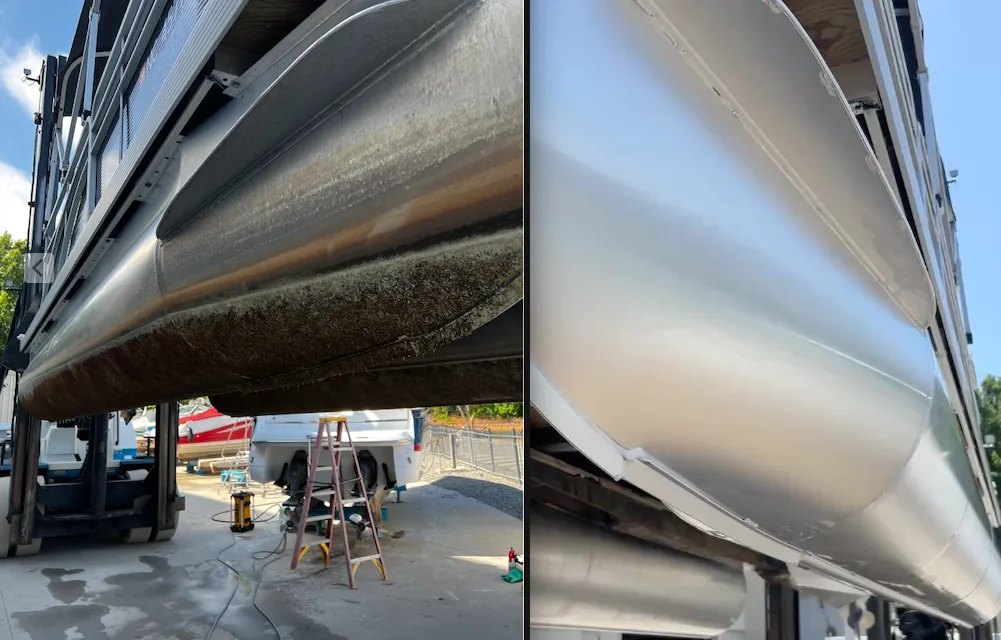
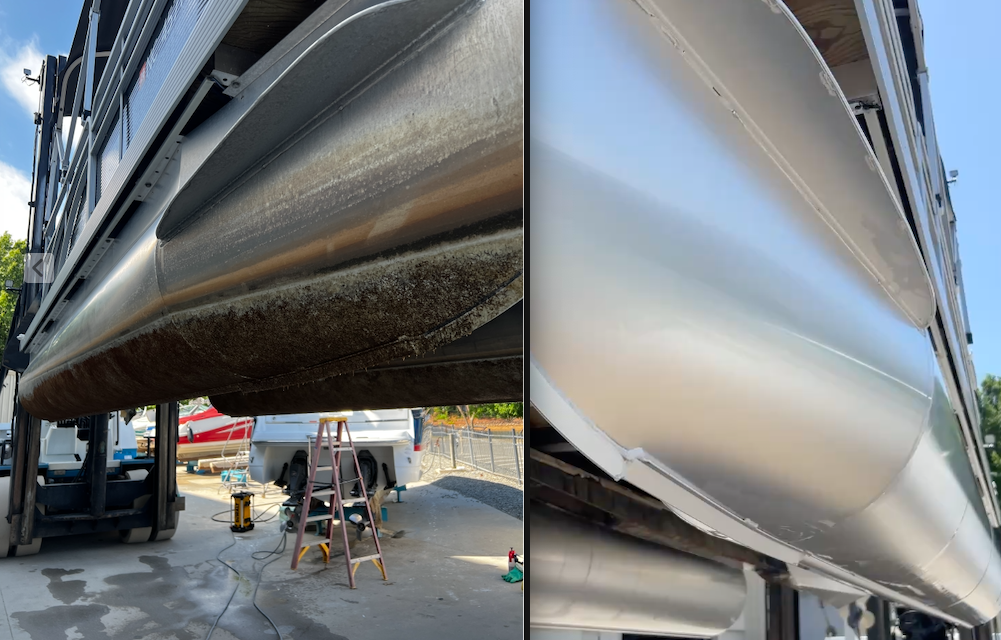
- Aluminum tubes: This is the big one. Tubes develop oxidation, water stains, and algae buildup — especially this summer with Lake Norman water levels still running 2–3 feet below normal. More tube is exposed to air and UV, which means oxidation is worse than usual. I use an aluminum-specific brightener (never on fiberglass), hand-apply it in sections, and rinse thoroughly. On heavily oxidized tubes, I'll follow up with a polish to bring back the shine.
- Vinyl seats and upholstery: Mold, mildew, sunscreen stains, and UV fading are the four enemies. I clean each panel with a marine-grade vinyl cleaner, treat any mold spots individually, and finish with a UV-protectant conditioner that keeps the vinyl from cracking through July and August heat.
- Gel coat and fiberglass panels: Side panels and the transom get oxidized and chalky if they're not maintained. I wash, clay if needed, then compound and polish to restore the gloss. On pontoons that have sat all winter, I'm often doing light correction work just to get the shine back.
- Bimini top and canvas: Pollen season ran hard through May and into June this year. Every bimini top I've touched in the last month has had a thick yellow layer baked on. I clean the canvas, treat the stitching for mildew, and re-waterproof if it's starting to leak through.
- Deck, non-skid, and hardware: The deck gets a full scrub, all hardware gets cleaned and dried, cup holders get detailed out, and the helm area gets wiped down. It's the small stuff that makes a pontoon feel new again.
Why Pontoons Need More Attention Than You'd Think
Pontoon owners tend to assume their boat is low-maintenance because it's not a performance hull. That's partly true — you're not dealing with the same gel coat surface area as a Mastercraft or a Malibu. But pontoons have more vinyl, more aluminum, and more flat surfaces collecting water, pollen, and UV damage than any other boat on the lake.
The tubes alone are a project. Aluminum oxidizes fast in fresh water, and the drought conditions on Lake Norman this summer mean those tubes are sitting higher and baking in the sun more than they would in a normal year. I'm seeing tubes come in with oxidation bands that are 6–8 inches wider than last summer just because of the low water.
Dock-to-Dock — I Come to Your Slip
Every pontoon detail I do is mobile. I bring my own water, power, and every product needed to your dock — whether that's at Safe Harbor in Mooresville, Crown Harbor in Cornelius, River City Marina, Holiday Harbor in Denver, or a private dock off Brawley School Road. You don't have to haul your boat anywhere.
For pontoons that need tube work below the waterline, I'll coordinate with your marina on a haul-out so I can get full access to the tubes, running gear, and hull bottom. That's the only way to do it right when the oxidation extends below what I can reach at the dock.
How Often Should You Detail Your Pontoon?
For a pontoon that's in the water from April through October on Lake Norman, I recommend a full detail at least twice during the season — once in late spring after pollen season wraps up, and once in late summer before you start thinking about winterization. If you're running your boat every weekend, a mid-summer touch-up on the vinyl and a quick tube rinse goes a long way.
Ceramic coating is also an option for pontoon owners who want to cut down on maintenance. I'm Glidecoat Pro Certified with over 1,200 boats coated, and I've done plenty of pontoon tubes and gel coat panels. A ceramic coat won't eliminate the need for cleaning, but it makes pollen, water spots, and algae slide off instead of bonding to the surface.
Book Your Pontoon Detail Before Black Boat Weekend
Black Boat Weekend is June 19–21 this year, and it's the biggest boating event on Lake Norman all summer. If your pontoon hasn't been touched since you pulled the cover off in April, now is the time. I'm booking pontoon details through June and slots fill up fast once the lake gets busy.
Call or text me at (704) 594-3948 to get your pontoon on the schedule. I'll come to your dock, assess what your boat needs, and get it looking the way it should before the busiest weekend of the year.