How to Prepare Your Boat for Ceramic Coating

Why Prep Work Makes or Breaks Your Ceramic Coating
I've coated over 1,200 boats on Lake Norman, and I can tell you exactly why some ceramic coatings last three years and others start peeling in three months. It's not the product. It's not the brand. It's what happens before the coating ever touches your gel coat.
Ceramic coating locks in whatever is on your hull — good or bad. If you apply it over oxidation, polishing oils, or embedded contaminants, you're sealing in the problem. The coating bonds to those impurities instead of your gel coat, and within weeks you'll see haze, peeling, and water that no longer beads the way it should.
Here's exactly how to prepare your boat for ceramic coating the right way — the same steps I follow on every job at Crown Harbor, Safe Harbor, River City Marina, and every private dock from Cornelius to Denver.
Step 1 — Strip Wash to Remove Old Protection
A regular maintenance wash won't cut it. You need a strip wash that removes all existing wax, sealant, and silicone residue from the gel coat. I use a high-concentration marine soap without any wax additives. Those "wash and wax" products from the marine store are the opposite of what you want here — they leave a film that prevents the ceramic from bonding.
With Lake Norman's pollen season running May through June, most boats I see at this point are coated in a layer of yellow pine pollen baked onto old wax. That all has to come off completely before anything else happens.
Step 2 — Chemical and Mechanical Decontamination
After the strip wash, run your hand across the hull. If it feels gritty or rough — like fine sandpaper — you've got embedded contaminants. Iron particles from nearby construction, mineral deposits from Lake Norman's water, tree sap from overhanging branches at marinas like Holiday Harbor. A clean-looking hull can still be loaded with invisible contamination.
I spray an iron remover across the entire hull first. Where it turns purple, it's reacting with iron particles and dissolving them. Then I follow up with a clay bar or clay mitt, working section by section with plenty of lubrication. This pulls out everything the chemical decontamination missed. Skip this step and you're trapping those particles under the coating permanently.
Step 3 — Paint Correction: Compound and Polish
This is where 70% of the actual work happens, and it's the step most people skip or rush through. Ceramic coating is not a scratch remover. It's not going to fill in oxidation or hide swirl marks. Whatever your gel coat looks like when you apply the coating is exactly what it will look like for the next two to three years — just locked in.
On a typical Lake Norman boat that's been sitting through winter, I'm starting with a gloss meter reading in the 40s or 50s. For boats stored on open water — especially with this year's drought exposing more hull to direct sun — I've been seeing readings in the 30s. That means oxidation has eaten into the surface layer.
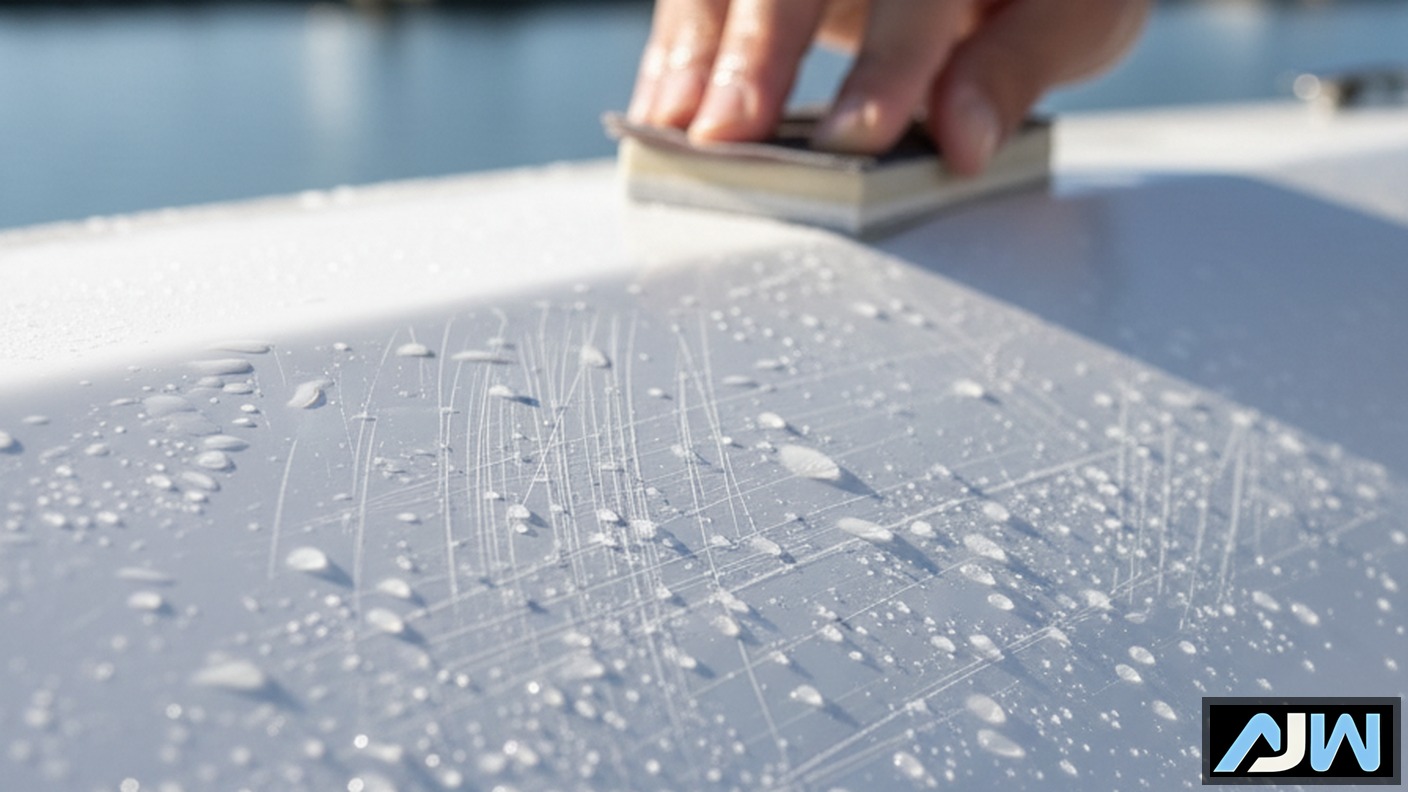
The correction process follows a specific sequence: wet sand the heavily oxidized areas first, then compound to remove deeper scratches and restore clarity, then polish to bring the surface to a smooth, high-gloss finish. On most boats I detail along Brawley School Rd and the Hwy 150 corridor, I'm targeting gloss meter readings in the mid-90s to 100 before I'll even open a bottle of ceramic.
When You Don't Need Full Correction
Not every boat needs wet sanding. If your gel coat is in decent shape — minimal oxidation, no deep scratches, gloss readings already in the 70s or above — a single-step polish might be all you need. I measure before I quote so you're not paying for work your boat doesn't need.
Step 4 — The IPA Wipe That Most People Forget
This is the step that separates a coating that lasts from one that fails. After compounding and polishing, your gel coat is covered in polishing oils. They make the surface look incredible — glossy, deep, rich. But those oils sit between the gel coat and the ceramic coating, and they prevent the coating from cross-linking with the surface.
I wipe down the entire hull with a 30/70 mix of isopropyl alcohol and distilled water on a clean microfiber towel. Every panel, every section, until the towel comes back clean. This strips away all polishing residue and leaves bare, corrected gel coat ready for the ceramic to bond directly to.
I've seen boats come in for re-coating after six months because someone else skipped this step. The coating looks fine at first, but once it rains or the boat sits in the water for a few weeks, it starts lifting. That's a prep failure, not a product failure.
Step 5 — Check Conditions Before You Apply
Even with perfect prep, applying ceramic coating in the wrong conditions can ruin the job. I'm looking for surface temperatures between 50°F and 80°F, low humidity, and no direct sunlight on the panels I'm coating. On Lake Norman in June, that usually means starting early morning at the dock before the sun hits the hull directly.
High humidity accelerates curing time, which sounds good until you realize it means you have less time to level and buff each section. Rush it and you get high spots — cloudy, uneven patches that are nearly impossible to remove without starting over.
Why This Matters More Than the Coating Brand
People ask me all the time which ceramic coating is best. The honest answer is that a mid-range coating with perfect prep will outperform a premium coating with lazy prep every single time. I use Glidecoat Pro because I trust the product and I'm certified in their application process. But the reason my coatings last is the four hours of prep work that happens before the coating ever comes out of the bottle.
If you're thinking about ceramic coating for your boat this summer — or if you had a coating done somewhere else and it's already failing — give me a call at (704) 594-3948. I'll come to your dock anywhere on Lake Norman, measure your gel coat, and tell you exactly what your boat needs before we talk about coating options.